On Sleep Has Her House
Robert Eggers, Ethel Cain, Dennis Cooper, Nicole Brenez, Phil Solomon and others on Scott Barley’s first feature

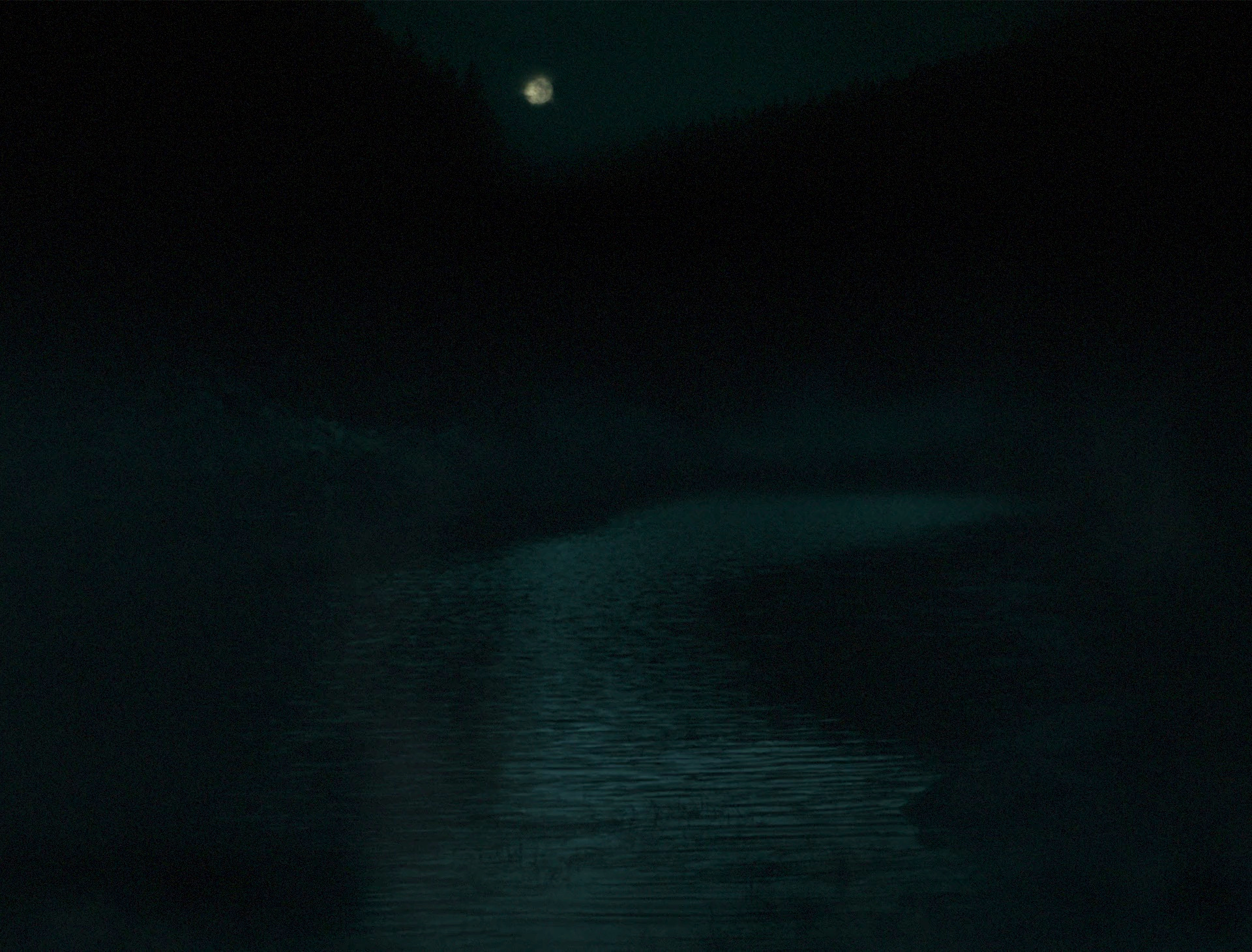
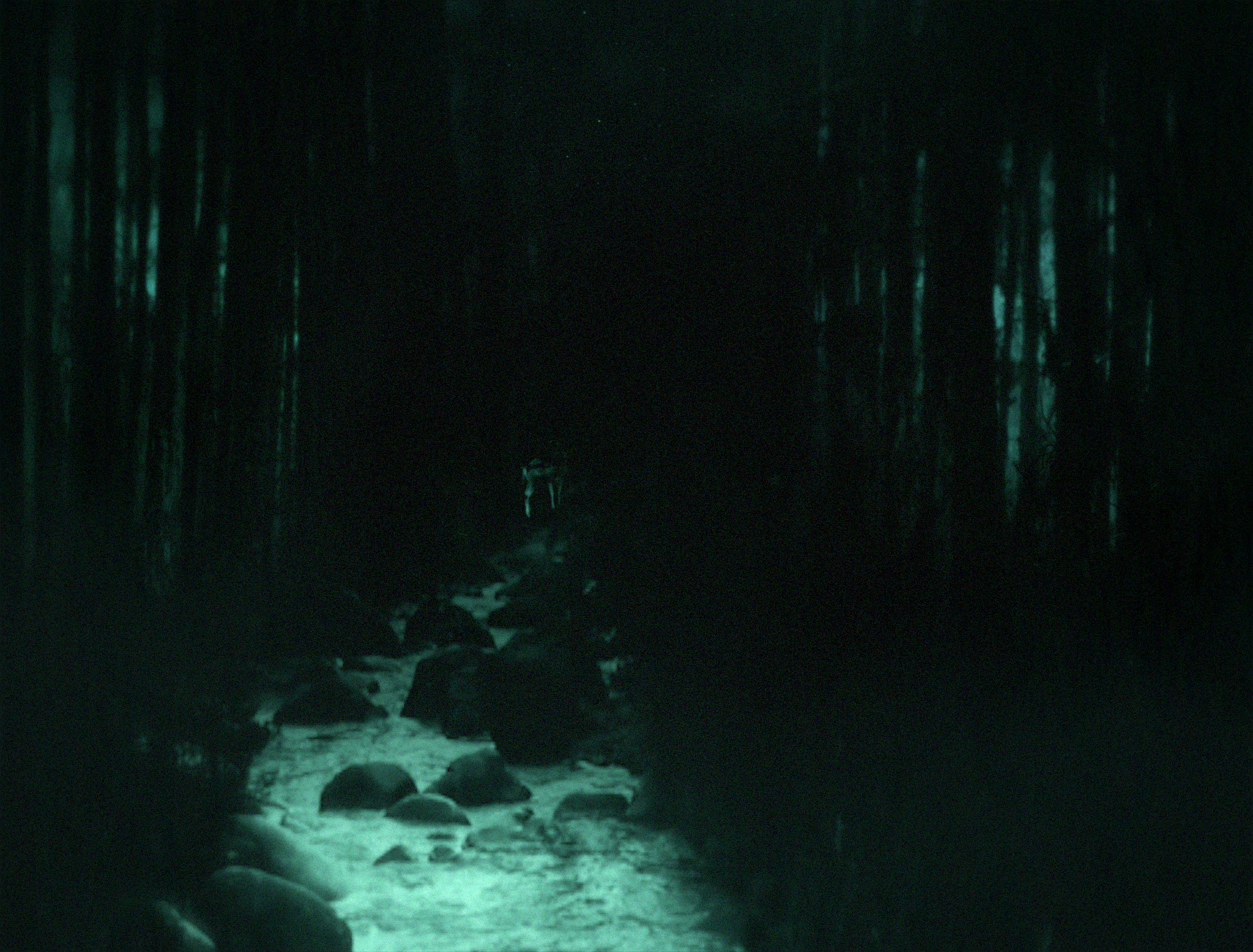
Sleep Has Her House (2017) is Scott Barley’s first feature. He made it alone, as director, camera, sound and editor, filming on an iPhone 6 Plus at 60 frames a second and slowing it to 24, and setting the footage among still photographs and his own drawings. It runs ninety minutes, in long static takes of forest, hills and water going into night.
It won the Jury Award for Best Film at the Fronteira International Documentary & Experimental Film Festival in Brazil, was voted for in Sight and Sound’s polls of 2017 and 2018 and in The Village Voice’s 2017 poll (as best film, best first feature and best director), and in 2022 received votes from both critics and directors in Sight and Sound’s Greatest Films of All Time poll. Nicole Brenez, researcher and editor on Jean-Luc Godard’s The Image Book, named it one of the ten best films of the decade.
It showed in the Doc/Visions strand at Sheffield Doc/Fest 2018, as a double bill with Wim Wenders’ Anselm at Eye Filmmuseum in Amsterdam, and in the six-month exhibition Climate of Cinema at the Museum of Contemporary Art Busan, alongside Chantal Akerman, Lav Diaz, Tsai Ming-liang and Jerzy Skolimowski. A book on the film carries a foreword by Brenez and essays by James Slaymaker, Maximilian Le Cain, Greg Hainge, Graiwoot Chulphongsathorn and Kevin John Bozelka; it has since been written about in Screen and discussed with Sean Cubitt at the University of Melbourne.
In 2025 Ethel Cain played the film’s score in her Artist in Residence series on BBC Radio 6 Music.
Dennis Cooper gave a day of his blog to Scott’s films: Scott Barley Day.
I first watched Sleep Has Her House in 2017 and loved it then. I loved it again on second viewing. Very immersive. Very inspiring.
Sleep Has Her House changed my life.
I realised how very long it had been since a new film both filled me with absolute wonder and satisfied my deepest cravings for cinema itself. It made me ask myself, ‘Where am I?’ in the most precise and hopeful way.
Unlike anything I have ever seen. Scott Barley has made a true work of art.
And suddenly, by the sheer force of Barley’s films, the artist tears away this veil of Maya, resistant to the flames of “barbaric” presence, to use the adjective of Jean Epstein; that is to say, a noumenal presence, not a phenomenal one. Suddenly someone is not content to “take for granted”, someone sees.
“When I look at the sky between the stars, I can only see what has disappeared” (Jean-Luc Godard, In the Darkness of Time, 2002). Like those of Jean-Luc Godard but conversely because they are radically minimalist in their production as in their design, the films of Scott Barley possess a visionary power. They contemplate what we censor; they define what we repress; they unfurl what we rebuff; they sublimate what we are unable to observe. But it is not only a question of our psychic processes, it is indeed the real objectified, targeted and sometimes attained by the hard sciences. Like those artists of the negative, such as William Blake who, in observing the stars had foreseen the existence of an antimatter long before physics could envisage it, Scott Barley offers us images of what is there but which, out of ignorance or anguish, we have mutated into absence.
On April 10th, 2019, the world cried with joy and amazement at the sight of the first image of a Black Hole, and this reaction was recognised by the spectators of Sleep Has Her House: just as scientists were gathering the data that would lead to the production of this image, in 2017, Scott Barley had recently finished his Black Hole, marking the end of his resplendent film, Sleep Has Her House. Science meets poetry.
There are moments within Sleep Has Her House of such exquisite and subtle rendering of “moving light in place” that I have always dreamed of experiencing in the cinema. A black forest film to be entered into only with great care and caution. Scott Barley has dared us to imagine a cinema of such fragile – and terrifying – beauty (reclaiming once again that real definition of “awesome”, the sublime) that places both the film and the viewer on equal footing of corporal existence by the closing credits.
Sleep Has Her House is a very beautiful film, hypnotic… I felt a dialogue with certain images in my own films, and especially in the relationships between sound and image. It is a film on the secret of the nature, on what the eyes do not see, but the soul does. Nature, phantasmagorical cinema, a state of shadows, of what? It never reveals to us. It is precisely the opposite of what cinema, as we know it, usually is. This telluric film is about the inner state that leads the spectator to have an astonishing relationship with the invisible. This is precisely a cinema which proposes to seek and think about the origin of images in itself.
An astonishing debut, written, produced, directed and edited by the 25-year-old British filmmaker Scott Barley, who shot his film on an iPhone. Slow cinema at its very best. … Sleep Has Her House is an exceptional landscape film in which tiny movements and subtle changes make a huge impression.
Sleep Has Her House is a grand elemental poem. It is a film that expresses the sublime through a meticulously crafted soundscape and the painting of light and darkness.
Two films have been firmly lodged in my mind since I saw them on consecutive days: Nathaniel Dorsky’s Arboretum Cycle and Scott Barley’s Sleep Has Her House.
Another sublime cinematic pastoral heading to the festival in the same Doc/Visions strand is British director Scott Barley’s eerie Sleep Has Her House, which hypnotically unfurls nature’s majesty.
Scott Barley’s Sleep Has Her House is a recent landmark of experimental cinema, combining recent trends in the landscape and slow cinema movements to produce a painstakingly crafted meditation on nature and the viewer’s gaze upon it.
Barley’s sombre yet hypnotic minimalist reverie is a timely reminder not only of the aesthetic possibilities of amateur filmmaking today but also of the ways in which cinema might adopt a different relationship to the natural world than those typically occasioned by the Anthropocene.
Existing on the peripheries of horror, video art and landscape painting, Sleep Has Her House is an experimental and contemplative film object. Only nature and some spectral animals act as characters in this truly singular work shot and made entirely by Scott Barley.
Redolent of the films of Sokurov and Tarkovsky, Scott Barley’s feature debut invites us to contemplate landscape, shape, texture and light, but often in absentia. It is a nocturne of long, static takes, wordless, yet vivid, even ecstatic in moments of searing, revelatory and indelible beauty. All the more remarkable, it was largely shot on an iPhone. An extraordinary work.
Like Warhol’s earliest films on sleep, sex and eating, and the fluxus experiments before them, Sleep Has Her House uses a composite of new and old technologies to recalibrate the audience to a slower, more primeval clock of waking and sleeping life.
Barley, an installation artist and filmmaker from Wales, has more in common with the long-dead Caspar David Friedrich, a 19th-century Romantic landscape painter, than any contemporary avant-gardist.
Sleep Has Her House is a 90-minute landscape film of minor movements and subtle changes; it’s at times so still, so tranquil the screen begins to resemble a projected painting. Then a stream will flow, a gust of wind will blow across the trees. But Sleep’s mostly unoccupied vistas—no humans, a few scattered animals—are entirely staggering in their audio-visual scope, not unified or mappable to the viewer, but always greater than we can see, more terrifying than what we can hear. Friedrich would often place meagre humans or their ruins in the foreground of a far greater natural backdrop. That is not necessary here; this is a film that by sheer aesthetic magnitudes dwarfs its spectator in every possible way.
Barley’s method is closer to Sokurov’s than Tarkovsky’s; he is not merely adopting the philosophy of a mode of painting, but distilling its form through the centrifuge of another medium.
Sleep Has Her House is a strange, contradictory amalgam; Barley is finding the terrible sublime not through a life-altering encounter with a thunderstorm or even an imagination of it through oil on canvas, but through grand footage shot on nothing less than an iPhone. With no words and no characters, Sleep Has Her House seeps down into the deepest crevices of our collective soul, engaging a fear spiritual in its disposition. This is a visual and aural language of the apocalypse, a crisis of faith in its purest, most elemental form.
Barley’s film is certainly the strongest film I have seen in years. There have been many films which touched me, but not in the same way. Sleep Has Her House stands out. This is as far as my words can take it. All I can do now is strongly recommend the film. Words cannot adequately translate experience. You naturally lose most of that experience because you try to find words for something that has no words.
Unlike a filmmaker like James Benning—to whom Barley has been compared—this filmmaking doesn’t so much seem to be calling for a return to the basic properties of nature to form a resistance against modernity in cinema practices as to suggest how painterly abstractions can be created through the simplest of means. Barley crafts images that are extremely sensual in their materialism but minimal in every other sense. Although each works in isolation, when placed in succession they take on an intense emotional weight, layer upon layer of painterly compositions in a rich tapestry of gentle motion.
If Sleep Has Her House at first calls to mind the expressionist landscapes of Peter Hutton, Victor Sjöström and, yes, Jean-Marie Straub, the formal apocalypse of its final act recalls the smeary digital cacophony of Lucien Castaing-Taylor and Véréna Paravel’s Leviathan, and Sleep Has Her House similarly foregrounds the forceful capacities of DV cameras. By removing his filmmaking from any traditional sense of narrative, character, and, even temporal/spatial unity, Barley invites us to see the world—and the cinematic image—anew.
Scott Barley’s Sleep Has Her House was the single most momentous hour and a half in the dark for me this year, a tenebrous landscape film shapeshifting between reality and nightmare, cinema and dream.
The last twenty minutes of the film depict the apocalypse, the end of the world and of images … In Sleep Has Her House, death – the end of the world – emerges as the transgression of a limit, an experience that is both ecstatic and intolerable, to the point that even the images can not record it (the screen is black). Paraphrasing Georges Bataille’s Eroticism, Sleep Has Her House, a beautiful debut, is a film that ‘affirms life even in death.’
Plunging us as deep as possible into the darkness both frightening and intimate, Sleep Has Her House provides one of the most unique watching experiences in years.
If Béla Tarr (of some parallel universe) had been asked to create an hour and a half intermission for the National Geographic after-midnight broadcast, the resulting opus would have certainly felt close to Barley’s cinematic phantasm.
To simply call it a movie feels inherently wrong. Sleep Has Her House is more akin to a transcendental experience; you are absorbed into a void where only light and darkness become the defining traits of existence.
Barley’s images cry “behold!” across valleys and mist-doused horizons, rendering timid pastoral British scenes into epic landscapes of Caspar David Friedrich. This is a document of uncanny stillness, of being isolated simultaneously in awe and daunted by the magnitude of the elements.
It is impossible not to appreciate Barley’s aesthetic sensibility in Sleep Has Her House. He gives us everything he has in this work … like that of Tarr, Sokurov or Tarkovsky, it is made in a way that requires the viewer’s involvement in an absolute way.
Sleep Has Her House was a special experience in that it showed me that film can dig deep into one’s unconsciousness and express something that you yourself would perhaps have no words for. But there are filmmakers like Scott, whose films do exactly this. They are the most experiential films I know and it is not all about slowness in his films. It is very much about experiencing whatever state you are in. I remember that I passed through a particularly tough time when I saw the film for the first time. I struggled with severe depression and I sometimes wondered whether life was worth it. Seeing Scott’s film made me become hyperaware of my state, but also of film as a way of therapy to help both viewer and filmmaker to purge themselves from whatever dark period one is passing through. Sleep Has Her House has always been more than just a slow film for me. At the Slow Film Festival, I saw the film for only the second time. The first time, my reaction to it was violent and intense, so intense that I couldn’t remember much of the images. They were blacked out in favour of the feeling that the film left me with. I was worried about seeing the film once more. I didn’t know what my reaction would be like. Seeing the film a second time felt like a process of remembering.
Painting with an iPhone! I had the most amazing aesthetic experience for a long time.
90 minutes with landscapes, rivers, valleys, woods, sunset, barely visible graphic prints on the film screen, from pleasure to nightmare, no dialogue, cinéma pur, a rollercoaster of impressions and associations, remembering our Danish master, Per Kirkeby when seeing some of the colourful images, ... or thinking of Casper David Friedrich of course but also of Muybridge and his horses, or maybe better of the white horse in Pirjo Honkasalo’s Three Rooms of Melancholia.
It’s Götterdämmerung without Wagner but with lightning and thunder at a sound level that made me want to hold my ears and close my eyes to avoid the epileptic seizures that I could have inherited from my father.
I can’t remember being so much physically attacked by the film medium. I read that Scott Barley was born in 1992, this Anselm Kiefer of cinema... gosh, I was suffering with this nightmarish pleasure!
A fittingly dark film, elementally black almost, both in terms of the images – many of which are filmed at the greatest depths of night or in such thick fog as to be almost indeterminable – and in the mood, one of mounting, crushing despair, or rather, fear in the face of enormity. Shot over four days across remote Wales and Scotland, with a post-production period lasting much longer, similar to the films that came before it but more impressive in almost every way. Here Barley showcases a sense of control that had eluded him before, creating consistently arresting images, commanding the pacing and building an atmosphere that shifts gradually but noticeably, from serenity towards chaos. The duration is essential too; it takes time for these sequences to have their effect, and really for the first time, they are afforded it.
Barley was originally a fine artist, and his filmmaking practice remains informed by his painting, recording individual images then layering them over each other into stacked plains, a “method that brings back a sense of texture and tactility that I loved from painting in a sculptural way, where I was painting with my hands with large amounts of oils, ash, spider’s silk, stone, tree bark etc.”
This technique produces a dimensionality in the image, and also a plasticity, the effect of which is often astounding, the real made ethereal through mounting and manipulation, hundreds of representational images layered to make something much more uncanny. Hard, fixed single images become soft and malleable through duplication. An early extended sequence focuses on an enormous waterfall, the blending of the veneered images creating a blurred effect like that produced by slow shutter speed photography, but in motion. The sequence transitions seamlessly between shots recorded at different distances, the cuts made invisible through layering, creating a long take that moves magically between perspectives.
The film concludes with violence, a great storm made from a collage of deafening sonic constructions and increasingly indeterminable, obfuscated images (most striking: closeups of a horse’s eye, whitened and fearful) giving way to total apocalypse. The film’s final cataclysmic stroboscopic image seems to directly reference the filmmaker’s earlier experiments with total abstraction, where chaos was welcomed. A reset button smashed at the first sight of familiarity or comfort.
From here, it is hard to think where the filmmaker – already well underway in the production of another feature film – can move forwards. “I think we have not even come to close to understanding and manifesting the potential of what image in tandem with sound can create as an experience. I want to keep driving for that, and see how far we can go,” he says. Sleep Has Her House shows a filmmaker who is both iterating and innovating, starting from what is familiar and creating anew. His storm snarls and screams, bludgeons and batters, and ultimately wipes clean. In the wake of disaster, the filmmaker can pick up the pieces and start a new film, begin to build a new house.
In Sleep Has Her House, day and night are one. Light and dark are one. Film and photography and painting are one. And if I am loose enough to allow it, I am one with that creature with the unblinking eye. I have no need to determine if it is indeed a creature or an element of topography. I can marvel at its scaly green hue and not fret about making any figure/ground distinctions.
But categories persist. I am not loose enough to allow it. So I reach for likenesses of horror and perceive it all as a threat. And at last I have an idea as to why I cried at the end of my first screening of Sleep Has Her House. Barley has created a world of baffling sensations, one with the potential to redefine the very act of perception. But I cannot stay there.